
 Español
  Français
  Deutsch
  Italiano
  Nederlands
  International
Female hormone testing: The five key hormones for fertility and pregnancy search

When it comes to seeking pregnancy, hormones play a crucial role in the reproductive process. These chemicals are responsible for regulating the menstrual cycle, ovulation and endometrial receptivity, all essential elements to conceive a healthy baby.
We’ve talked to Dr. Alejandra García-Villalba, medical director of Vida Fertility Alicante about the key elements of a female hormone testing which are LH, FSH, estradiol, progesterone and AMH: their role in the search for pregnancy and how controlling their levels can help you on your way to become a mother.


- What are female hormones?
- Female hormone analysis: How they affect the search for pregnancy
- What hormonal problems indicate infertility?
- Beta-HCG: the pregnancy hormone
- Female hormone analysis: Why is it important to control them?
- How do I know if I have a condition that prevents pregnancy?
- Frequently asked questions on female hormone testing
- Need help? Contact us
- Our fertility treatments
- Where can I find Vida Fertility centres in Spain?
What are female hormones?
Hormones are chemical messengers that the body uses to coordinate different biological functions.
The menstrual cycle, key to female fertility, is controlled by a system known as the hypothalamus-pituitary-ovary axis. This axis regulates hormones that are essential for the cycle to function properly and for a woman to become pregnant.
The hypothalamus and pituitary gland, located in the brain, are responsible for sending signals to the ovary to release the necessary sex hormones. These hormones not only prepare the uterus for a possible pregnancy, but also influence women’s secondary sexual characteristics, such as breast development or the distribution of body fat.
When this system is not working properly and hormones are not released correctly, irregularities in the menstrual cycle can occur, making it difficult to become pregnant. This is why a hormone blood test is one of the most important female fertility tests when it comes to examining a woman’s fertility.
Vida Fertility Events
At Vida Fertility, we want to help our patients understand their treatment better.
We are convinced that a fertility process will be better lived, and with more
serenity, if the patient has received all the previous information.
For this reason, we organize events to inform, disseminate and explain how we adapt our processes to each person.
Female hormone analysis: How they affect the search for pregnancy
The menstrual cycle has two main controls: one from the brain (hypothalamus and pituitary) and one from the ovaries. Each of them plays a key role that we detail below in this article.
Pituitary hormones
FSH and LH: Hormones regulating the menstrual cycle
Follicle-stimulating hormone (FSH) and luteinising hormone (LH) work together to regulate the menstrual cycle.
- FSH: Stimulates the growth of follicles in the ovaries during the follicular phase.
- LH: triggers ovulation through a mid-cycle spike, allowing the release of the egg.
- Fertility treatment control: These hormones are evaluated especially at the beginning of the cycle to assess the level.
Ovarian hormones
Oestradiol: key to follicular and endometrial growth
Oestradiol, produced by the developing follicles, is essential for the growth of endometrial thickness.
- Importance: Adequate levels of oestradiol ensure that the endometrium reaches the thickness necessary for successful implantation.
- Follow-up in treatments: At Vida Fertility, we assess the oestradiol level to ensure that follicles are growing properly during the ovarian stimulation and that the level is adequate for the endometrial growth.
Progesterone: the hormone for the endometrial receptivity
After ovulation, the corpus luteum produces progesterone, which prepares the endometrium for embryo implantation.
- Importance: If the levels are insufficient, implantation may not be successful, which is known as implantation failure.
- Role in fertility treatments: At Vida Fertility, we monitor progesterone during IVF (In Vitro Fertilisation) cycles to check that women have not ovulated and in endometrial preparation cycles to check that there is no ovulation before the start of progesterone. We also check it the day of the embryo transfer to see if the level is adequate (normally >10ng/ml).
Anti-Müllerian Hormone (AMH): Indicator of the ovarian reserve
AMH is one of the most important hormones when it comes to female fertility. Produced by the developing follicles of the ovaries, its level can be used to estimate a woman’s ovarian reserve.
- Importance: The higher the AMH level, the better the ovarian reserve. If levels are low, it could be an indication of low ovarian reserve, which can make pregnancy difficult.
- Assessment at Vida Fertility: To assess your ovarian reserve, we measure AMH levels (through a blood test) along with an antral follicle count by transvaginal ultrasound.
This initial analysis is key to determine the most appropriate fertility treatment and optimal ovarian stimulation.
Female hormone testing: Normal values
Hormone monitoring is done by measuring sex hormones in the blood and comparing their values with normal ranges to assess female fertility:
| Hormones | Normal Levels |
|---|---|
| FSH | 3-9 mIU/ml |
| LH | 2-10 mIU/ml |
| TSH | 0.2-4.7 mIU/ml |
| Estradiol | 27-161 pg/ml |
| Progesterone | 5-20 ng/ml (on day 21) |
| Prolactin | 0-20 ng/ml |
| AMH | 0.7-3.5 ng/ml |
- FSH: Indicates ovarian reserve. Values between 3-9 mIU/ml are normal, while levels above 13 mIU/ml suggest very low reserve.
- LH: Normal values between 2-10 mIU/ml. A peak above 20 mIU/ml indicates ovulation, but high levels early in the cycle may suggest PCOS.
- TSH: Should be between 0.2-4.7 mIU/ml. Alterations indicate hypo- or hyperthyroidism. In addition, when searching for pregnancy, studies indicate that levels < 2-2.5 would be more favourable for implantation.
- Oestradiol (E2): Ideally at the start of the cycle, levels between 27-161 pg/ml.
- Progesterone: On day 21 after ovulation, normal values are between 5-20 ng/ml.
- Prolactin: Between 0-20 ng/ml in non-pregnant women and 10-300 ng/ml in pregnant women. Values above 30 ng/ml may indicate hyperprolactinaemia.
- AMH: Between 0.7-3.5 ng/ml. Lower values suggest very low ovarian reserve;
These values help to identify hormonal problems that may influence fertility and guide assisted reproductive treatments.
What hormonal problems indicate infertility?
There are several hormonal disorders that can negatively influence female fertility. The most common are:
- Polycystic Ovary Syndrome (PCOS): This endocrine disorder is characterised by an imbalance in female sex hormones, which often makes ovulation difficult. It can also be associated with a metabolic syndrome.
- Ovulatory dysfunction: This term encompasses disorders in which ovulation is irregular or absent.
- Hypothyroidism: This condition occurs when the thyroid gland produces an insufficient amount of thyroid hormones, which can interfere with ovulation and endometrial development, making it difficult to get pregnant.
- Hyperprolactinaemia: This disorder is characterised by elevated levels of prolactin, the hormone responsible for stimulating milk production. Hyperprolactinaemia can suppress ovulation and complicate the chances of pregnancy.
Are you having problems getting pregnant?
Beta-HCG: the pregnancy hormone
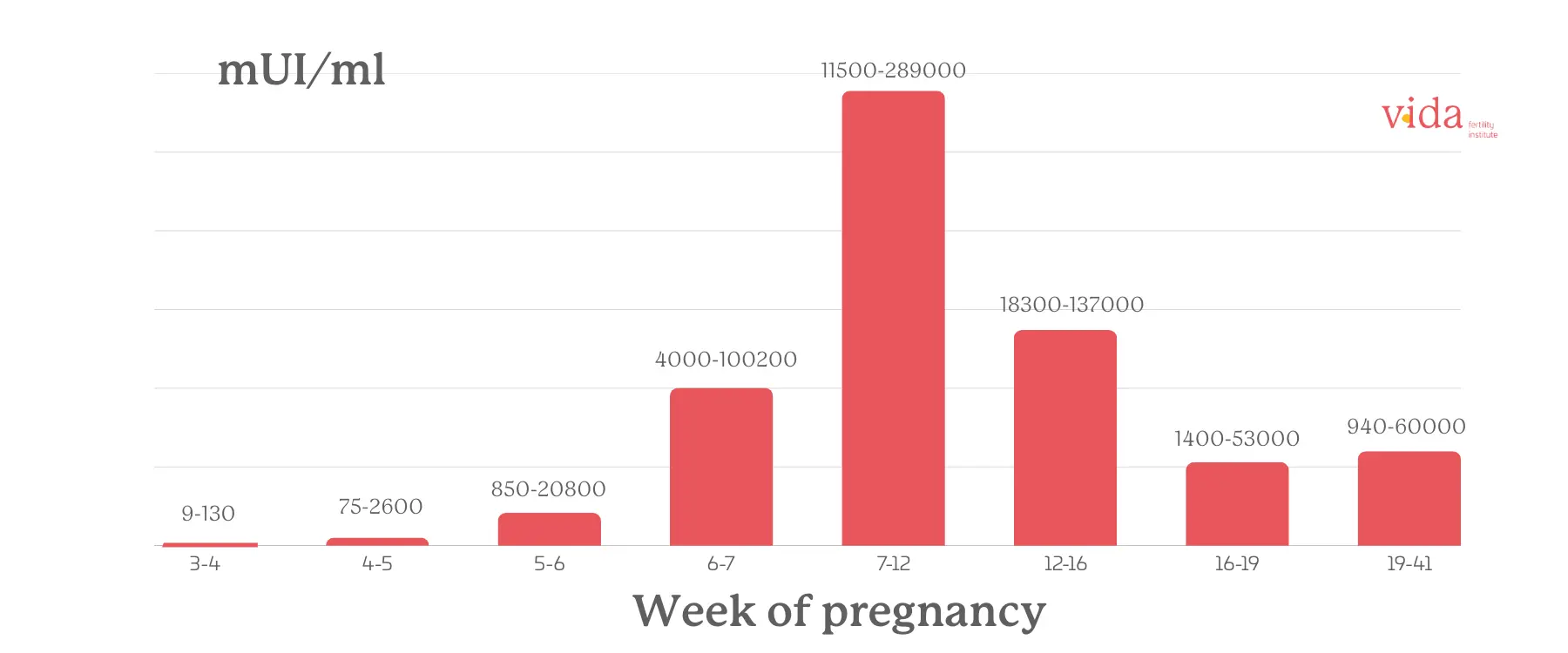
Human chorionic gonadotropin (beta-HCG) is known as the pregnancy hormone. Its presence confirms embryo implantation and development.
- Role: It is used to confirm pregnancy and monitor its evolution during the first weeks.
- Follow-up at Vida Fertility: We perform beta-HCG blood tests after assisted reproduction treatments to verify the success of the procedure.
Beta-hcg values
Female hormone analysis: Why is it important to control them?
A complete hormonal diagnosis makes it possible to identify the causes of infertility that hinder the search for pregnancy.
At Vida Fertility, we perform personalised analyses to evaluate each of these hormones, providing a treatment plan tailored to the individual needs of each patient.
How do I know if I have a condition that prevents pregnancy?
If you have been trying to conceive for six months to a year without success, we recommend a fertility and hormone test to identify possible obstacles.
- Advanced hormone studies: We assess key hormone levels to identify imbalances that may affect your fertility.
- Personalised diagnosis: We combine hormone profile, ultrasound and other fertility tests to design a unique treatment plan for you.
- Comprehensive support: Our multidisciplinary team is here to accompany you every step of the way, from diagnosis to the most appropriate treatment.
Learn more about fertility check-up.
Frequently asked questions on female hormone testing
1. Which hormones are analysed in a fertility test?
AMH, FSH, LH, oestradiol and progesterone are the main investigated hormones. Complementary studies may also be included when there is a risk of recurrent miscarriages, such as the thrombophilia study.
2. When should I have a hormone test?
If you have been trying to get pregnant for 6 months to 1 year and you are not getting pregnant, you should go to a fertility specialist and have a fertility test to find out why you are not getting pregnant.
Basic hormone profile is usually performed in the first few days of the menstrual cycle to obtain accurate information about basal fertility hormones.
3. What if I have a hormonal imbalance?
Hormonal imbalances can lead to serious fertility-related difficulties.
For example, excessive or insufficient FSH or LH production can interfere with the menstrual cycle and the ovulation process. Similarly, imbalances in oestradiol and progesterone levels can hinder implantation.
An imbalance can be treated with medication or with the help of assisted reproductive techniques to optimise your chances of conceiving.
4. Is it possible to get pregnant with low AMH levels?
In many cases, women are not aware that they have low AMH levels or low ovarian reserve until they decide to try to get pregnant.
After a period of unprotected sex without success in achieving pregnancy, it is often time for fertility testing, where low ovarian reserve is often diagnosed.
In these situations, and by evaluating all the factors associated with the couple, there are various assisted reproduction strategies and treatments that can help a woman to fulfil her dream of becoming a mother.
Need help? Contact us
If you have been trying to get pregnant for more than 6 months and have not been successful, we encourage you to take the first step. Schedule your first free consultation with us and find out how we can help you fulfil your dream of becoming a mother.
Ask for a consultation for Female hormone testing
You may also like





Last news about Female hormone analysis


Testimonials













Where can I find Vida Fertility centres in Spain?

📍 C/ Palermo 15, Hortaleza, 28043 Madrid
📞 Phone number: +34 919 29 83 23
🕒 Opening hours: Monday to Friday from 8am to 7pm
📍 Av. Óscar Esplá 1, Bajo, 03008 Alicante
📞 Phone number: +34 919 29 83 23
🕒 Opening hours: Monday to Friday from 8am to 7pm
ℹ️ The information published on Vida Fertility is reviewed by our fertility specialists and medical team, following up-to-date scientific criteria and evidence-based medicine. Our team is a member at scientific societies such as SEF, ESHRE and SEGO.