
 Español
  Français
  Deutsch
  Italiano
  Nederlands
  International
Sperm selection in the laboratory is the work prior to fertilisation, which allows the best spermatozoa to be selected in order to optimise embryo quality.
Sperm selection can be basic or advanced, depending on the quality of the sample obtained.
At the Vida Fertility laboratory, we have the most advanced and appropriate techniques for each case.
Sperm selection techniques

Advanced sperm selection techniques
Sperm selection in the laboratory is the work prior to fertilisation, which allows the best spermatozoa to be selected in order to optimise embryo quality.
Sperm selection can be basic or advanced, depending on the quality of the sample obtained.
At the Vida Fertility laboratory, we have the most advanced and appropriate techniques for each case.
Who is it for?
Sperm selection is suitable for a wide range of patients seeking assisted reproductive treatment, including those with male infertility problems such as low sperm motility, poor sperm morphology, or low numbers of viable sperm.
It is also useful for couples who have experienced implantation failure in previous IVF cycles, thus improving the chances of success in future conception attempts.
ICSI fertilisation and selection technique
The ICSI technique of sperm micro-injection is used systematically in our laboratory. It consists of microscopically selecting the spermatozoa with the best morphology, vitality and movement, in order to optimise the fertilisation of the egg.
Once the spermatozoa have been selected, they are injected directly into the interior of the egg in an attempt to provoke fertilisation. This technique increases fertilisation rates, especially in cases of limited sperm quality. The ICSI technique of sperm micro-injection is used systematically in our laboratory. It consists of microscopically selecting the spermatozoa with the best morphology, vitality and movement in order to optimise the fertilisation of the egg.
Once the spermatozoa have been selected, they are injected directly into the interior of the egg in an attempt to provoke fertilisation. This technique increases fertilisation rates, especially in cases of limited sperm quality.

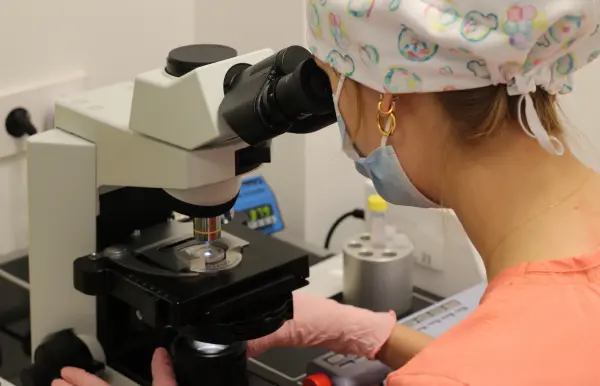
Microfluidic technique
It is a type of sperm selection that allows us to choose the healthiest spermatozoa for the Assisted Reproduction Treatment. These chips simulate the cervical and uterine pathways sperm must navigate through to naturally fertilise an egg. By mimicking this process, we can separate the sperm in a healthier and more efficient way without using harmful products or centrifugation.
How is the process of sperm selection technique using chips?
It is a process that stands out for being intuitive, simple and fast. In addition, it does not require centrifugation or sample pretreatment, avoiding possible iatrogenic damage of the process itself.
There are two types of chips: Zymot™ ICSI and Zymot™ Multi. Depending on the type of sample and the assisted reproduction technique that we are going to perform, we will use one or the other.
In both cases the fresh semen sample is placed on the chips and after an incubation of approximately 30 minutes at 37ºC we will proceed to collect the spermatozoa for their use in the chosen reproductive technique.
Other sperm selection techniques
In some cases, and especially in the case of very limited sperm quality, the microfluidic technique cannot be applied. In these cases, our laboratories will be able to identify which technique can be used to optimise sperm selection:
- Spermslow technique : allows the selection of spermatozoa at home with low concentration.
- Spermobile technique : indicated for patients whose sample comes from a testicular biopsy (either performed on the day of the puncture or from frozen testicular biopsy samples), in patients diagnosed with necrozoospermia and OligoAstenoTeratozoospermia. This technique makes it possible to recover motility in immotile spermatozoa.


Specialists in sperm selection
Sperm selection using microfluidic chips represents a significant advance in assisted reproduction, allowing healthy sperm to be selected by mimicking the natural selection process in the cervical and uterine tracts.
This intuitive method, which does not require centrifugation, protects sperm from damage, optimising the chances of success in fertility treatments.
If you are looking to improve your chances of conceiving, contact Vida Fertility to explore how this technology can benefit you on your path to parenthood.
Questions about sperm selection techniques
In in vitro fertilisation (IVF) treatments, sperm selection is a key step. Our goal is to choose the sperm with the best motility, morphology and genetic quality, as this directly influences fertilisation and embryo development.
At Vida Fertility, we use different advanced selection techniques, such as microfluidic microchips, ZYMOT or Spermslow, adapted to each case according to the semen analysis, medical history or history of previous failures.
Zymot ICSI is a microfluidic sperm selection system that reproduces the natural conditions of the female tract. Thanks to this technology, sperm with better morphology, greater motility and less DNA fragmentation are selected, which favours the production of higher quality embryos.
It is indicated in cases of high sperm DNA fragmentation, implantation failure, poor embryo quality in previous cycles, or recurrent miscarriages. The procedure is part of an IVF cycle with ICSI: the semen sample is placed in the device, where the most suitable sperm pass through the microfluidic channels without the need for centrifugation, reducing oxidative stress. They are then selected to fertilise the retrieved eggs and generate embryos with greater implantation potential.
SpermSlow is a sperm selection method that uses hyaluronic acid to mimic the natural process of egg and sperm binding. This technique allows sperm with less DNA fragmentation to be selected, improving the quality of fertilisation and embryonic development, especially in cases of male infertility. Unlike other techniques such as FertileChip, SpermSlow can also be applied to cryopreserved samples, offering greater versatility in the laboratory.
A testicular biopsy (TESE or micro-TESE) is a surgical procedure that allows sperm to be extracted directly from the testicle, particularly recommended for men with azoospermia (absence of sperm in the ejaculate).
At Vida Fertility, we work with specialist urologists who perform this technique in the operating theatre under anaesthesia. The sperm obtained is processed and stored for use in an IVF cycle with ICSI.
It is a safe, useful technique and often the only reproductive option for many men.
No. Testicular biopsy is performed under sedation, so the procedure itself is not painful.
After the procedure, there may be mild discomfort or swelling for a few days, which can be easily controlled with painkillers. Our medical and laboratory team will accompany you throughout the process to ensure a quick and complication-free recovery.
A 4% normal sperm count (according to Kruger criteria) is considered to be within the lower range of normal, but it does not mean that you cannot achieve pregnancy.
The most important thing is to assess the other parameters of the semen analysis (concentration, motility, vitality, etc.) and, if necessary, carry out additional tests such as sperm DNA fragmentation or FISH.
At Vida Fertility, we adapt sperm selection techniques to each sample to optimise fertilisation and embryo quality, even in complex cases.