
 Español
 Français
 Deutsch
 Italiano
 Nederlands
 International

Ovarian and Reproductive Physiology: Developmental Changes as Women Age

The ovary fulfils two essential functions: it produces hormones and enables the maturation of oocytes. Both are related to the menstrual cycle and fertility. They also change over the course of a woman’s life: the ovarian reserve gradually decreases and, as a woman ages, the quality of the oocytes changes.
Dr Sergio Rogel Cayetano, a gynaecologist specialising in assisted reproduction and scientific director of Vida Fertility, addresses these aspects in his lectures on reproductive physiology as part of the University of Alicante’s Master’s in Continuing Professional Development in Human Fertility.
In this article, we explain the main concepts of this subject and what implications they have for understanding fertility.


- What are the functions of the ovary?
- How is the ovarian reserve formed?
- Which hormones regulate the ovarian cycle?
- What are the phases of the menstrual cycle and how do they relate to fertility?
- How does ovarian function change with age?
- What role does the endometrium play in the reproductive cycle?
- What should be borne in mind regarding ovarian physiology?
- Our fertility treatments
- The best fertility clinics in Spain
What are the functions of the ovary?
The ovary is the female gonad. It has both an endocrine and a reproductive function, which are co-ordinated throughout a woman’s fertile life.
Its endocrine function consists of producing hormones, mainly oestrogens and progesterone. These hormones play a part in the menstrual cycle and act on various tissues in the body.
Their reproductive function is to harbour and allow the maturation of oocytes. In each cycle, a group of follicles begins to develop, although usually only one goes on to ovulate. The others cease to develop through a process called atresia.
For this reason, the cycle visible on the menstrual calendar is only part of a process that begins much earlier and depends on the coordination between the brain, hormones and the ovaries.
How is the ovarian reserve formed?
Oocytes begin to form before birth. During foetal development, germ cells multiply and then enter meiosis, the process that halves the genetic information so that fertilisation can take place.
Meiosis is halted before the first division is completed. The oocytes remain in this state for years, until some resume their maturation as part of an ovulatory cycle. The pre-ovulatory LH surge plays a part in the resumption of this process.
The oocytes are surrounded by cells and form the primordial follicles. According to data cited in Dr Rogel’s explanation for the UA’s Master’s degree programme, the number of germ cells peaks during foetal life and decreases significantly before puberty. Only a small proportion will actually ovulate throughout a woman’s reproductive life.
This reduction is caused by atresia, a natural process that affects the follicles at different stages. Ovulation is just one of the ways in which the reserve decreases: the majority of follicles never mature or release an oocyte.
Which hormones regulate the ovarian cycle?
The functioning of the ovary depends on communication between the hypothalamus, the pituitary gland and the ovarian hormones themselves.
Hypothalamus
The hypothalamus releases GnRH in pulses. This signal reaches the pituitary gland and regulates the production of the gonadotropins involved in the cycle.
Pituitary gland
The pituitary gland produces FSH and LH. FSH is involved in the growth and development of the follicles. LH plays a part in the final maturation of the follicle, triggers ovulation and promotes the formation of the corpus luteum.
Ovarian hormones
The follicles produce oestrogens as they grow. After ovulation, the corpus luteum produces mainly progesterone, as well as oestrogens. These hormones act on the endometrium and, via feedback mechanisms, influence the secretion of FSH and LH.
The ovarian and endometrial cycles are not separate processes: they progress in a coordinated manner to prepare the body for possible fertilisation and implantation.

What are the phases of the menstrual cycle and how do they relate to fertility?
Menstruation
If pregnancy does not occur, the corpus luteum degenerates and concentrations of progesterone and oestrogen decrease. This drop in hormone levels causes the functional layer of the endometrium to shed, which is expelled as menstrual bleeding.
At the same time, the reduction in hormonal feedback allows FSH levels to rise and the recruitment of a new cohort of follicles to begin.
Follicular phase
During the follicular phase, several follicles begin to develop. The process has an initial stage independent of gonadotrophins and a subsequent stage in which FSH is required for some follicles to continue growing.
The follicles compete with one another. The one that responds best to FSH—due, amongst other factors, to its hormonal sensitivity—may become dominant. Its activity promotes oestrogen production. As oestrogen levels rise, FSH levels fall and the less sensitive follicles cease to develop.
Dr Rogel’s presentation points out that follicular recruitment does not begin solely with menstruation: the development of follicles capable of ovulation extends over a preceding period of several months. Therefore, what occurs in a specific cycle may reflect processes that began much earlier.
Ovulation
When the dominant follicle reaches maturity, an LH surge occurs, triggering ovulation. The oocyte is released from the follicle and can be fertilised if sperm are present at the same time.
Following ovulation, the cells of the follicle transform to form the corpus luteum. This produces progesterone, which is necessary to transform the endometrium and promote its secretory phase.
Luteal phase
During the luteal phase, the corpus luteum continues to produce hormones. Progesterone helps to prepare the endometrium for possible implantation.
If pregnancy does not occur, the corpus luteum degenerates and a new cycle begins. If pregnancy does occur, hCG initially helps to maintain the function of the corpus luteum.
How does ovarian function change with age?
The ovarian reserve declines over the course of a woman’s life. As well as a reduction in the number of oocytes, their quality may also change with age. Age influences the likelihood of an oocyte successfully completing meiosis and giving rise to an embryo with the potential for development.
Oocytes remain in a dormant state for many years before resuming meiosis. This long pause is one of the biological factors linked to the increase in chromosomal abnormalities as a woman gets older. Age alone does not determine a woman’s individual situation, but it is an important factor in assessing fertility.
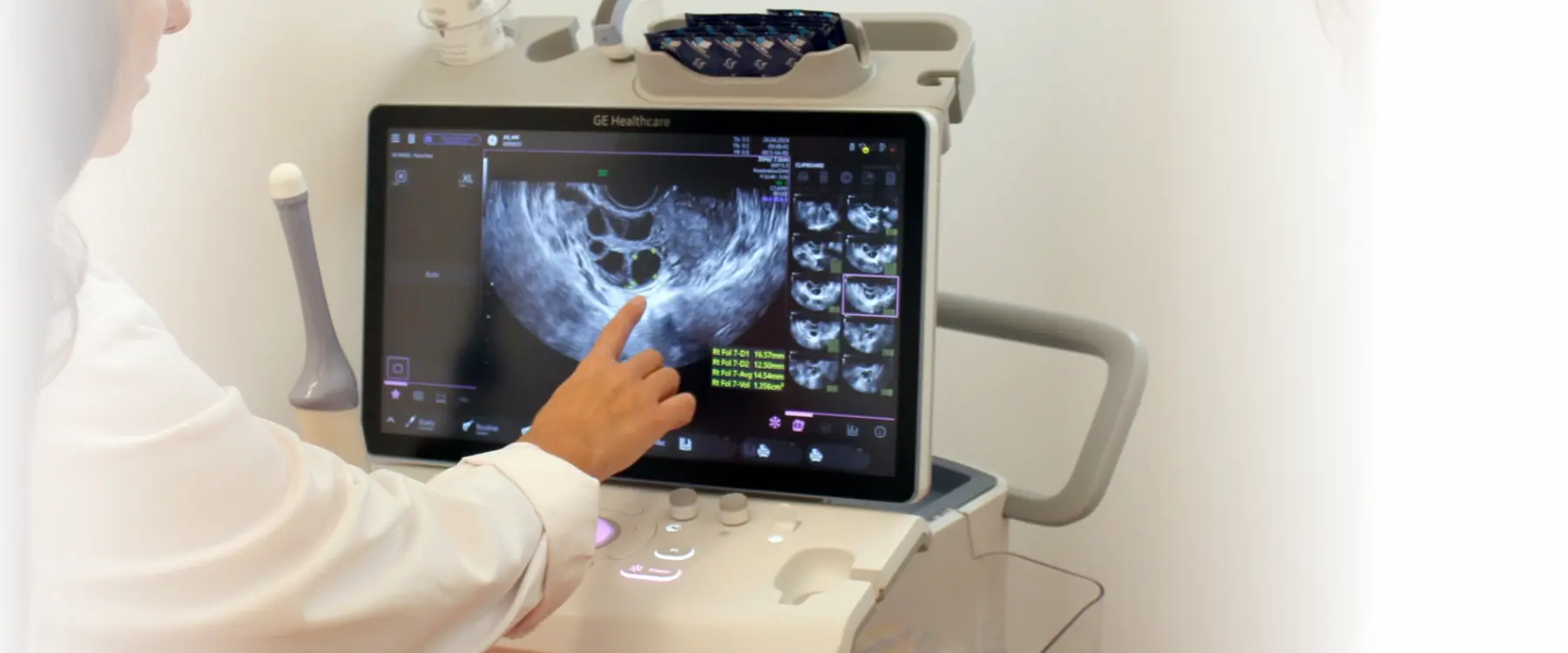
Ovarian reserve and oocyte quality are related, but they are not the same thing. Anti-Müllerian hormone (AMH) and antral follicle count help to estimate the number of available follicles and can provide information on the response to ovarian stimulation. They do not allow for a direct measurement of oocyte quality nor can they, on their own, predict the likelihood of pregnancy. The ASRM also emphasises that these markers must be interpreted in conjunction with age and the clinical context.
What role does the endometrium play in the reproductive cycle?
As the follicle grows, oestrogens stimulate the proliferative phase of the endometrium. After ovulation, progesterone promotes the secretory phase: the glands and blood vessels continue to develop and the endometrium prepares for possible implantation.
If pregnancy does not occur, ovarian hormone levels fall and the functional layer is shed. The basal layer remains and helps to regenerate the endometrium for the next cycle.
The synchronisation between follicular development, ovulation and endometrial changes forms part of reproductive function. Understanding this coordination helps to explain why fertility depends on several processes rather than on a single hormonal outcome.
What should be borne in mind regarding ovarian physiology?
The ovary produces hormones and houses the oocytes that can mature during the reproductive lifespan. The formation of the ovarian reserve begins before birth; follicular recruitment and selection occur continuously; and the menstrual cycle reflects the coordination between the hypothalamus, the pituitary, the ovaries and the endometrium.
As we age, the ovarian reserve declines and oocyte quality may be affected. Reserve tests provide useful information, but they are no substitute for an individual clinical assessment and cannot, on their own, predict reproductive outcomes.
If you have any concerns about your ovarian reserve or wish to explore your reproductive options, the Vida Fertility team can review your case on an individual basis. Request an initial assessment.



Vida Fertility Events
At Vida Fertility, we believe that feeling informed is the first step towards a more confident fertility journey.
Through our events, talks and private consultations, we help patients understand their options, ask questions and receive personalised guidance from our fertility specialists in Spain.
Discover our upcoming events and meet the Vida Fertility team.
Ask for a consultation
You may also like


Last news


Testimonials





The best fertility clinics in Spain
📍 C/ Palermo 15, Hortaleza, 28043 Madrid
📞 Phone number: +34 919 29 83 23
🕒 Opening hours: Monday to Friday from 8am to 7pm
📍 Av. Óscar Esplá 1, Bajo, 03008 Alicante
📞 Phone number: +34 919 29 83 23
🕒 Opening hours: Monday to Friday from 8am to 7pm
ℹ️ The information published on Vida Fertility is reviewed by our fertility specialists and medical team, following up-to-date scientific criteria and evidence-based medicine. Our team is a member at scientific societies such as SEF, ESHRE and SEGO.