
 Español
  Français
  Deutsch
  Italiano
  Nederlands
  International
Ovarian size: what is considered normal? If they increase in size by a few millimetres, does this affect fertility?

Many patients come to the clinic concerned about the size of their ovaries as stated in their ultrasound report. They want to know whether their ovaries are too small, too large, or the right size to get pregnant.
The size of the ovaries can provide useful information about a woman’s reproductive health, but this measurement alone does not determine fertility. It must be interpreted in conjunction with the woman’s age, the phase of her menstrual cycle, her antral follicle count, her hormone levels and the appearance of the ovaries on the ultrasound scan.
In this article, Dr Elena Santiago, a fertility specialist at Vida Fertility Madrid, explains what is considered a normal ovarian size, why it varies, and what these measurements might mean if you are trying to conceive.


- What is the size of the ovaries in mm?
- Does the size of the ovaries change during the menstrual cycle?
- How does the size of the ovaries change with age?
- Does the size of the ovaries affect fertility?
- Does having large ovaries affect fertility?
- Can small ovaries indicate a low ovarian reserve?
- What can cause the ovaries to become enlarged?
- How is ovarian size assessed?
- Can lifestyle changes improve ovarian size or egg quality?
- When should you seek a fertility assessment?
- Frequently asked questions about the size of the ovaries
- Our fertility treatments
- The best fertility clinics in Spain
What is the size of the ovaries in mm?
They contain follicles, release eggs and produce hormones such as oestrogen and progesterone.
During a woman’s reproductive years, an adult ovary is usually described as measuring approximately 3.5 x 2 x 1 cm:
- 30–40 mm in length
- 20–30 mm in width
- 10–20 mm in thickness
However, there is no single ‘ideal’ measurement that applies to all women. Ovarian dimensions vary naturally depending on age, the menstrual cycle, hormonal activity and individual anatomy.
Doctors may also assess ovarian volume, which is calculated from the three dimensions recorded during an ultrasound scan. As reference ranges may vary between women and depending on imaging protocols, the result should always be interpreted by a fertility specialist.
Does the size of the ovaries change during the menstrual cycle?
Yes. It is entirely normal for the size and appearance of the ovaries to change during the menstrual cycle.
Ovarian size during the follicular phase
At the start of the cycle, several small antral follicles may be visible. Normally, one of these becomes the dominant follicle and grows until ovulation.
Ovarian size during the ovulation phase
A mature follicle may measure approximately 18–24 mm before releasing the egg.
This is the size of the folicle, not the egg itself. An oocyte is microscopic and cannot be measured during a standard ultrasound scan.
After ovulation, the follicle develops into the corpus luteum, a temporary structure that produces progesterone.

These physiological changes can make one ovary appear larger than the other. Therefore, a difference between the right and left ovaries is not abnormal.
How does the size of the ovaries change with age?
The ovaries change throughout a woman’s life.
They are small during childhood and grow at the onset of puberty. During the fertile years, their size may vary with each menstrual cycle. From around the age of 30, ovarian volume tends to decrease progressively as the number of remaining follicles declines.
Ovarian size during the menopause
After the menopause, the ovaries usually shrink in size because ovulation has ceased and hormonal activity has decreased.
Whilst during the fertile years they may measure between 3 and 5 cm, after ovarian activity ceases they usually shrink to approximately 0.5–1 cm and have a volume of less than 2 ml.
At this stage, an increase in ovarian size is not considered a normal physiological change. If an ultrasound scan detects an enlarged ovary, a cyst or a mass, it is important to undergo a gynaecological assessment to determine its cause and rule out any possible conditions.
Age is also the main factor affecting both the number and the chromosomal quality of the remaining eggs. Consequently, two women with similar ovarian measurements may have very different reproductive circumstances if they are of different ages.
Does the size of the ovaries affect fertility?
The size of the ovaries may be related to the ovarian reserve, but it is not a direct measure of fertility.
The ovarian reserve describes the estimated number of eggs remaining in the ovaries. A smaller ovarian volume may sometimes be accompanied by a reduced count of antral follicles, particularly as a woman gets older. However, small ovaries do not automatically mean that pregnancy is impossible.
Does having large ovaries affect fertility?
It depends; larger ovaries do not necessarily mean greater fertility. An increase in size may be related to a growing follicle, but it could also be due to the presence of multiple follicles, a functional cyst, an endometrioma or polycystic ovarian morphology.
During the consultation, we do not make decisions based solely on ovarian dimensions. We assess the full clinical picture to determine whether the measurement is simply an individual variation or part of a condition requiring further investigation.
Can small ovaries indicate a low ovarian reserve?
Small ovaries may be associated with a lower number of follicles, but ovarian size alone cannot confirm a low ovarian reserve.
A more comprehensive assessment of ovarian reserve usually takes into account:
- Age and menstrual history
- Antral follicle count on ultrasound
- Anti-Müllerian hormone (AMH)
- Other hormonal tests where clinically indicated
- Previous ovarian surgery or fertility treatments
- Medical conditions that may affect the ovaries
AMH and antral follicle count primarily help to estimate the potential response to ovarian stimulation. They do not directly measure egg quality or guarantee the likelihood of a natural pregnancy.
A woman may have a low ovarian reserve and still ovulate regularly. Conversely, having regular periods does not necessarily confirm that the ovarian reserve is normal.
What can cause the ovaries to become enlarged?
An ovary may appear temporarily enlarged around the time of ovulation without this being a sign of disease. Other possible explanations include:
- Functional ovarian cysts
- Polycystic ovarian morphology
- Endometriomas associated with endometriosis
- Benign ovarian tumours
- Ovarian stimulation during fertility treatment
- Less commonly, other ovarian conditions requiring further investigation
Having polycystic-looking ovaries is not the same as having polycystic ovary syndrome (PCOS). PCOS is diagnosed through a combination of clinical, hormonal and ultrasound findings. Ovarian size alone is not sufficient.
If an enlarged ovary is accompanied by sudden or severe pelvic pain, vomiting, fever, abdominal swelling or unusual bleeding, it is important to see a doctor promptly.

How is ovarian size assessed?
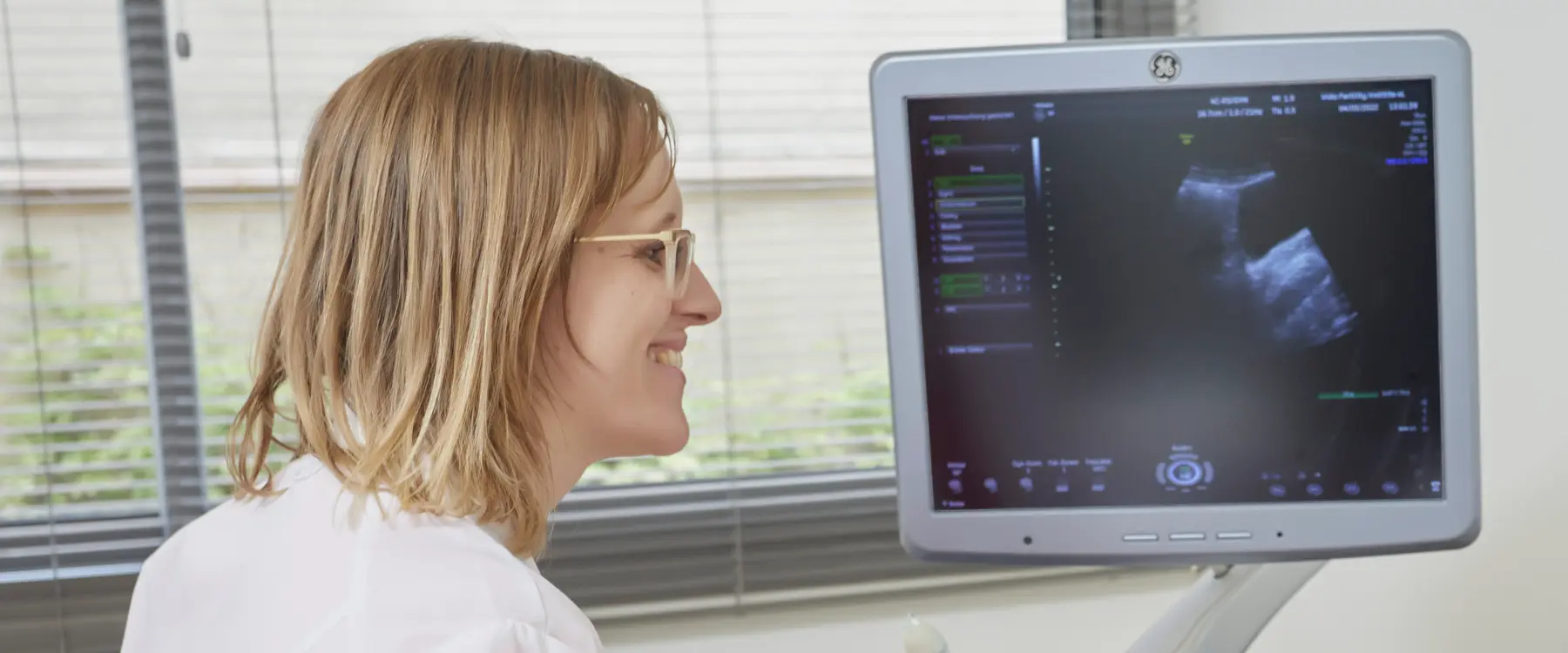
Transvaginal ultrasound is usually the most useful test for assessing the size and function of the ovaries in women of reproductive age. It allows the specialist to assess:
- The three dimensions of the ovaries and the calculated volume
- The number of antral follicles
- The presence of a dominant follicle or a corpus luteum
- Ovarian cysts or endometriomas
- Polycystic ovarian morphology
- The relationship between the ovaries and surrounding structures
When investigating fertility, ultrasound results are usually considered alongside AMH levels and, where appropriate, other hormone tests. This combined assessment is far more informative than any single piece of data from an ultrasound report.
Can lifestyle changes improve ovarian size or egg quality?
There is no treatment, diet, supplement or exercise programme with proven efficacy that can increase ovarian reserve or restore eggs that have already been lost.
However, healthy habits can support general and reproductive health:
- Avoid smoking
- Follow a varied and balanced diet
- Exercise regularly without overexerting yourself
- Maintain a healthy weight for your individual health status
- Limit your alcohol consumption
- Prioritise sleep and emotional wellbeing
- Consult a doctor before taking any supplements
These measures cannot halt reproductive ageing, but they can help create healthier conditions ahead of natural conception or fertility treatment.
When should you seek a fertility assessment?
Consider seeing a fertility specialist if you have been trying to conceive for 12 months without success, or after six months if you are aged 35 or over.
It may be advisable to have an assessment sooner if you have irregular periods or no periods at all, have had previous ovarian surgery, suffer from endometriosis, have a family history of early menopause, or have an abnormal finding on an ultrasound scan.
At Vida Fertility, we can review your ultrasound scan, your medical history and your ovarian reserve markers to explain what the results mean in your specific case.
Leave your details or book an initial consultation with our team. Understanding your ovarian health now can help you make informed decisions about your next steps regarding fertility.
Frequently asked questions about the size of the ovaries
Dr Santiago, a gynaecologist and fertility specialist, answers:
Is it normal for one ovary to be larger than the other?
Yes. It is common for there to be slight differences between the two ovaries, which may reflect follicular activity during the menstrual cycle. A specialist should assess a marked difference or an ovary containing a cyst or other visible structure.
What is the ideal size of the ovaries for getting pregnant?
There is no specific ovarian size that guarantees pregnancy. Ovulation, age, egg quality, ovarian reserve, the health of the fallopian tubes and the uterus, and factors relating to sperm all influence the likelihood of conception.
Does an increase in the size of the ovaries indicate PCOS?
Not necessarily. The ovaries may appear larger due to normal follicular activity, a cyst, ovarian stimulation or other conditions. PCOS requires a more comprehensive clinical and hormonal assessment.
How big is an ovary with a cyst?
There is no single measurement, as the size of the ovary depends on the size and type of cyst. A cyst can significantly increase the size of the ovary, but the ultrasound report should record both the dimensions of the ovary and those of the cyst separately. We also assess whether the cyst is simple or complex, its appearance, symptoms, age and the phase of the menstrual cycle. Size alone cannot determine the nature of the cyst or its effect on fertility.
What happens if my ovary measures 22 cm?
An ovary measuring 22 cm would be significantly enlarged and requires immediate assessment by a gynaecologist. This may be due to a large cyst or another ovarian mass, but its size alone does not indicate whether it is benign or malignant.
Firstly, check that the report states 22 cm and not 22 mm, as 22 mm may fall within the normal range for ovarian size. Sudden, severe pain, nausea, vomiting, dizziness or increased abdominal swelling require urgent medical attention, as they may indicate torsion, rupture or haemorrhage.
Does the size of the ovaries predict egg quality?
No. Egg quality is closely related to age, but cannot be determined from the size of the ovaries, AMH or follicle count. These measurements primarily provide information on the number of eggs and the potential response to stimulation.






Vida Fertility Events
At Vida Fertility, we believe that feeling informed is the first step towards a more confident fertility journey.
Through our events, talks and private consultations, we help patients understand their options, ask questions and receive personalised guidance from our fertility specialists in Spain.
Discover our upcoming events and meet the Vida Fertility team.
Ask for a consultation
You may also like



Last news


Testimonials







The best fertility clinics in Spain
📍 C/ Palermo 15, Hortaleza, 28043 Madrid
📞 Phone number: +34 919 29 83 23
🕒 Opening hours: Monday to Friday from 8am to 7pm
📍 Av. Óscar Esplá 1, Bajo, 03008 Alicante
📞 Phone number: +34 919 29 83 23
🕒 Opening hours: Monday to Friday from 8am to 7pm
ℹ️ The information published on Vida Fertility is reviewed by our fertility specialists and medical team, following up-to-date scientific criteria and evidence-based medicine. Our team is a member at scientific societies such as SEF, ESHRE and SEGO.