
 Español
  Français
  Deutsch
  Italiano
  Nederlands
  International
Sperm capacitation: what it is, values and tests in the in vitro laboratory

Sperm capacitation is the process by which spermatozoa with the highest probability of fertilising the egg are obtained. We talk to Dr. Beatriz Lozano about what it is and what techniques are used to wash and select the best sperm.


It is a process by which the sperm are prepared to increase their chances of fertilising the egg. In other words, the spermatozoa have to undergo certain changes in order to fertilise, which take place between ejaculation and the encounter with the egg.
Live sperm capacitation
Fertilisation of the egg takes place in the female reproductive tract, so the sperm must be able to reach this point in order for fertilisation to take place. This movement is not the only criterion necessary for the sperm to fertilise the egg. During the journey from the ejaculate to the fallopian tubes, a series of biochemical changes occur that prepare the sperm to penetrate and fertilise the egg.
In vitro sperm capacitation
In the fertility laboratory, we try to mimic these biochemical changes during the processing of semen samples. Although, strictly speaking, semen processing differs from live capacitation, it is possible to select spermatozoa with better conditions such as motility or lower fragmentation index
In vitro sperm capacitation techniques
These methods allow the selection of spermatozoa with the best prognosis for fertilisation and development for use in fertility treatments.
Density Gradients
It uses media of different densities to separate the spermatozoa, both from the spermatozoa with the worst prognosis and from other components or cells that may appear in the semen. The two density gradients are placed on top of the semen sample, which is then centrifuged to obtain different phases or layers depending on the density of the cells, with the spermatozoa with the best development capacity being found in one of them.

Swim-up
In this technique, the semen sample is mixed with culture medium and centrifuged, resulting in spermatozoa at the bottom of the tube. Subsequently, the upper part of the medium (where there would be cellular debris and other compounds) is removed and new culture medium is added. On this culture medium, the spermatozoa with the best motility should swim upwards (hence the name swim-up), and those that reach the surface are selected.
What is in vitro sperm capacitation for?
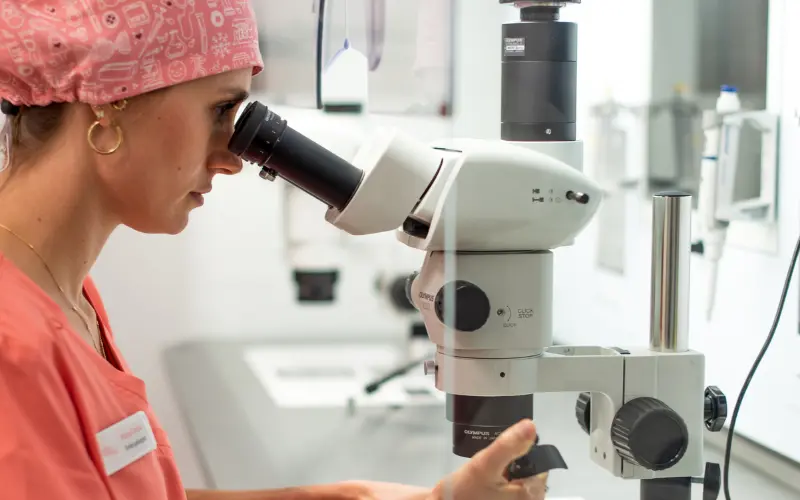
As we have seen above, it is difficult to simulate biochemical changes in the laboratory, so in vitro sperm capacitation serves another purpose. During capacitation, immotile spermatozoa, cells or cellular debris and seminal plasma are removed, thus ensuring a higher quality sample.
Sperm capacitation therefore aims to prepare the sperm sample by selecting as many motile and functional spermatozoa as possible.
This process, also known as “motile sperm retrieval” (MSR), together with the semen analysis, provides the information needed to decide on the most appropriate fertility treatment, such as directed intercourse, artificial insemination, IVF or ICSI.
Reasons for performing motile sperm counts
Semen analysis is one of the first steps in evaluating male infertility and determining whether there are problems with sperm production or quality.
Approximately half of all couples who have difficulty conceiving have a male infertility problem. On occasions, this semen analysis can be lacking in information, especially when determining the type of treatment to be performed. For this reason, the motile sperm count provides essential information for assisted reproduction treatments.
Sperm capacitation at Vida Fertility
At Vida Fertility we use REM analysis of the semenogram as a diagnostic test of sperm viability to analyse the sperm’s ability to move using the two aforementioned techniques: density gradients and the swim-up method. In addition, during the fertilisation process, we use sperm selection techniques such as Zymot, which, in addition to selecting according to motility, allows us to obtain spermatozoa with a lower DNA fragmentation index.
Duration of sperm capacitation process
Dr. Beatriz Lozano responds:
Sperm capacitation in the laboratory from the time the patient leaves the sample until the sperm are obtained usually takes between 30 and 60 minutes:
- Density gradients: This method separates and concentrates spermatozoa by centrifugation. Motile sperm are trapped in a specific phase, while those with low motility, cellular debris and other compounds are separated in other parts of the gradient.
- Swim-up: In this case, the sample is also centrifuged to remove the seminal plasma and concentrate the spermatozoa. Fresh culture medium is then added and incubated. It is here that the spermatozoa select themselves, as they must swim upwards, from which the sample to be used and/or evaluated will be obtained.
Sperm capacitation test values
Dr. Beatriz Lozano responds:
According to WHO data, sperm capacitation results are normal when:
- The sample volume must be equal to or greater than 1,4 ml.
- The pH should be in the range of 7.2 to 8.0.
- The sperm concentration must be equal to or greater than 16 million sperm per millilitre.
- The total number of spermatozoa in the ejaculate must be equal to or greater than 39 million spermatozoa.
- Progressive motility must be equal to or greater than 30%.
- Total motility must be equal to or greater than 42%.
- More than 54% of the sperm must be alive.
- At least 4% of the spermatozoa must have a sperm morphology
Who should undergo in vitro sperm capacitation?
Dr. Beatriz Lozano responds:
Sperm capacitation is recommended in patients with previous surgical interventions or pathologies (varicocele, inguinal hernias, testicular inflammation, etc.). We will be able to assess more exhaustively the reproductive capacity and if there has been any affectation due to these situations.
In addition, in cases where pregnancy has been sought without success for more than a year (or six months if you are over 35). In these cases, it is recommended that you consult a fertility specialist.
From a social point of view, the constant production of spermatozoa in the male presupposes optimum male fertility, but there are numerous factors that may be altering the correct production of spermatozoa and producing male factor infertility, consult us if you need to evaluate options for achieving pregnancy.
Book an appointment
You may also like




Last news


On Instagram

Testimonials






ℹ️ The information published on Vida Fertility is reviewed by our fertility specialists and medical team, following up-to-date scientific criteria and evidence-based medicine. Our team is a member at scientific societies such as SEF, ESHRE and SEGO.