
 Español
  Français
  Deutsch
  Italiano
  Nederlands
  International
Getting pregnant through artificial insemination: real chances, how many attempts and how to improve success

In Spain, it is estimated that approximately 1 in 6 couples of reproductive age have difficulty conceiving. And although these figures are more common than they seem, when it happens to you, it feels very different.
Assisted reproduction is not an easy journey, because it presents you with decisions, tests, waiting periods and results that sometimes don’t arrive when you need them most.
But you don’t have to go through it alone. In this article, written by Dr Katharina Spies, you will find straightforward answers on how to get pregnant through artificial insemination, how many attempts are usually recommended, what can go wrong and what you can do to improve your chances. And if, once you’ve finished reading, you’d like a personalised plan, you can book a face-to-face consultation at our fertility clinics in Spain, or do so online.


- What is artificial insemination and what types are there?
- Requirements for artificial insemination
- Chances of getting pregnant with artificial insemination
- How many AI attempts are needed to achieve pregnancy??
- What can go wrong with artificial insemination?
- How to increase your chances of getting pregnant through artificial insemination
- When to consider in vitro fertilisation
- Differences between in vitro fertilisation and artificial insemination
- Two-week wait, symptoms and pregnancy tests following artificial insemination
- Precio de quedar embarazada con inseminación artificial en España
- Frequently asked questions about artificial insemination
- Book your consultation at Vida Fertility
- Our fertility treatments
- The best fertility clinics in Spain
What is artificial insemination and what types are there?
Artificial insemination is a simple assisted reproduction technique. It involves preparing the semen sample in the laboratory – this is known as sperm capacitation and depositing a small amount into the uterus using a cannula, guided by ultrasound, at the most fertile point in the menstrual cycle.
Depending on the source of the semen, we refer to:
- IAC, conjugal insemination or insemination with partner’s semen
- IAD, insemination with donor semen
In the process of artificial insemination, it is important to note that male factors can affect the treatment’s chances of success, as there may be several factors preventing fertilisation.
Requirements for artificial insemination
To become pregnant through artificial insemination (AI) , it is first important to confirm that certain basic medical conditions are met. These requirements may relate to the woman and, if there is a male partner, also to semen quality. Before starting treatment, we usually review a series of preliminary criteria, including the following:
Permeable fallopian tubes
Fertilisation takes place in the fallopian tubes. If they are not permeable, AI cannot work. Permeability is assessed using tests such as hysterosalpingography (HSG), amongst others.
Good semen quality
Following the semen analysis, we assess the MTC (motile sperm count) after preparation.
Age and ovarian reserve
Did you know that female fertility declines from the age of 35? We are referring to the concept of ovarian reserve and, after carrying out the basic female fertility test, the AMH, we observe a decline in the number and quality of eggs available in the ovaries. At Vida Fertility, in some cases, we recommend that from the age of 37–38, in vitro fertilisation is usually considered directly.
Chances of getting pregnant with artificial insemination
How many AI attempts are needed to achieve pregnancy??
Studies on assisted reproduction show that, if pregnancy is not achieved on the first attempt at artificial insemination, it is reasonable to repeat the insemination in subsequent cycles.
In practice, it is usually recommended to complete up to 4 cycles of AI; however, if pregnancy is not achieved, it is important to consider switching treatment to techniques such as IVF or ICSI.
- At clinics such as Vida Fertility, between 2 and 4 attempts at artificial insemination are recommended, provided the woman is under 38 years of age and all requirements are met.
- If pregnancy is not achieved after these unsuccessful attempts, we recommend moving on to in vitro fertilisation or ICSI.
What can go wrong with artificial insemination?
Discussing why AI might fail is not about assigning blame, nor does it mean there are no further options. Often the reason is something that can be adjusted in the next cycle; at other times, it simply means that AI was not the most suitable technique for your case and it is advisable to change strategy before wasting any more time and energy.
The most common reasons why artificial insemination does not result in pregnancy and what can be done in each situation to improve your chances are:
Biological factors
- Success is not always achieved on the first attempt.
- Age and egg quality.
- Poor ovarian response.
- Exact timing of ovulation.
- Semen quality.
Tubal and diagnostic factors
- Fallopian tubes with functional damage, even if they appear patent.
- Endometriosis.
- Infertility of unknown cause which, after several attempts, requires a change of strategy.
Uterine and implantation factors
- Non-receptive endometrium.
- Polyps, submucosal fibroids or uterine problems.
- Adhesions or chronic endometrial inflammation.
Treatment and procedural factors
- Timing of insemination.
- Type/dose of ovarian stimulation and adjustments to ultrasound monitoring.
- Semen preparation and clinic-laboratory coordination.
Health and lifestyle factors
- Smoking and alcohol.
- BMI and fertility and their impact on ovulation and the endometrium.
- Hormonal imbalances (thyroid, prolactin, PCOS, insulin resistance).
- Stress.
- Nutrition and fertility.If you’ve read this far, you might be interested in booking a appointment with one of our doctors, asking questions, discussing your case and exploring the chances of getting pregnant through artificial insemination.
How to increase your chances of getting pregnant through artificial insemination
When starting assisted reproduction treatment, there are recommendations that can increase the success of the treatment:
- Ensure you meet the requirements for artificial insemination: age and ovarian reserve, AMH levels, patent fallopian tubes, semen quality.
- Attend all appointments and follow all guidelines from the clinic and the doctor managing your case: ultrasound monitoring and medication adjustment
- High-quality laboratory and semen preparation
- Healthy lifestyle: Sleep, smoking, alcohol, weight, chronic stress… all influence the success of pregnancy.
- Nutrition and fertility: reduce ultra-processed foods, take supplements such as folic acid, and increase your intake of a Mediterranean-style diet: pulses, vegetables, fruit, protein and healthy fats such as avocado.
When to consider in vitro fertilisation
IVF is considered when there are more serious problems, such as blocked fallopian tubes or severe male factors. Artificial insemination is often chosen totreat less severe causes of infertility, such as sperm quality or cervical issues.
Consulting a fertility specialist is crucial to determine the best option for each patient.
Differences between in vitro fertilisation and artificial insemination
A few months ago we wrote an article on the differences between IVF and artificial insemination, which we have summarised in this table:
| Treatment | Artificial Insemination (AI) | In Vitro Fertilisation (IVF) |
|---|---|---|
| Procedure | Introduction of sperm directly into the uterus. | Fertilisation of the egg in the laboratory and subsequent transfer. |
| Fertilisation | Occurs inside the woman’s fallopian tube. | Fertilisation takes place outside the body in an IVF laboratory. |
| Complexity | Simple and less invasive procedure. | More complex procedure requiring surgical intervention for egg retrieval and transfer. |
| Who is it for? | Women under 35 years old without tubal issues, endometriosis, or sperm-related problems. For mild or unexplained infertility. | Severe infertility, uterine issues, male factors, low ovarian reserve, advanced age. |
| Success rates | Between 15-20% per cycle, depending on age and infertility cause. | Between 50-60%, depending on age and embryo quality. |
| Cost | More affordable. | Higher treatment cost. |
| Number of attempts | Usually recommended up to 2-3 cycles. | Fewer attempts needed, higher success rate on the first cycle. |
| Treatment duration | Approximately 15 days. | Between 3 and 5 weeks, including ovarian stimulation and transfer. |
Two-week wait, symptoms and pregnancy tests following artificial insemination
Pregnancy symptoms following artificial insemination may resemble those of a natural pregnancy, but they can also be confused with the effects of the cycle’s hormonal medication.
To confirm that you are pregnant, we must wait 15 days; we call this period the beta-wait, so named because the pregnancy test analysed is for the beta-hCG hormone, which is the most reliable pregnancy test to date.
Beta-hCG levels
Beta-hCG hormone levels rise progressively from the start of gestation until the first trimester of pregnancy, after which they begin to decline gradually.
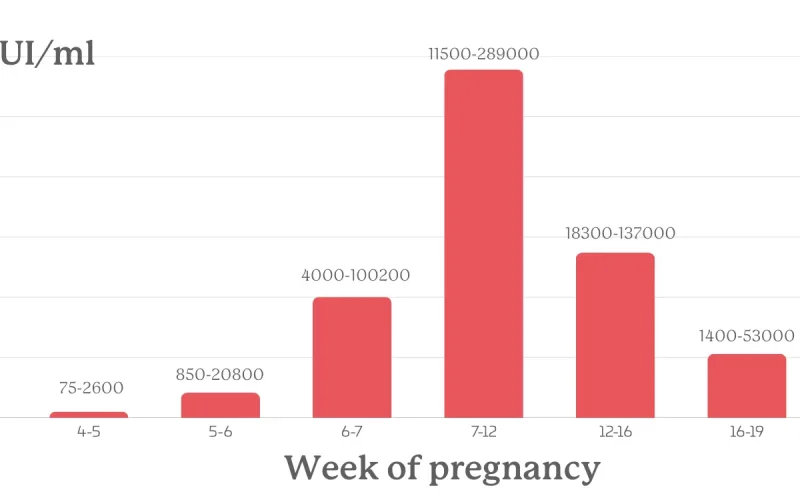
As a general guide, if you have a blood test on day 14, a value below 25 mIU/mL is considered indeterminate, whilst a value above 25 mIU/mL is interpreted as positive. The trend is important, as in the first few weeks beta-hCG increases every 48–72 hours. If levels either rise or fall, your medical team will arrange follow-up tests and, as the weeks progress, an ultrasound scan to confirm whether it is a developing pregnancy or one that is not progressing.
Precio de quedar embarazada con inseminación artificial en España
The cost of artificial insemination can be one of the most affordable options at assisted reproduction clinics; however, it is essential that a fertility expert assesses you beforehand, advises you and supports you in choosing the most suitable treatment.
At Vida Fertility, we ensure the quote is clear from the outset, detailing what is and isn’t included, so you can make decisions with peace of mind.
Frequently asked questions about artificial insemination
What are the chances of getting pregnant on the first attempt at artificial insemination?
There is a chance you could get pregnant on the first attempt at artificial insemination; however, according to Dr Spies, this depends on your requirements and diagnosis.
There is no single universal figure, which is why it is so important to tailor each case individually.
Home artificial insemination and kits: are they safe?
The Department of Health, through the CNRHA, warns of significant risks when using semen of uncertain origin, including genetic risks and the transmission of infections, as well as clinical risks such as multiple pregnancy or pre-eclampsia if medication is involved.
At Vida Fertility, we do not recommend this technique, as there may be genetic risks, infections and the possibility of multiple pregnancies. If you are considering this option, we encourage you to book an appointment with us; medical advice should always be prioritised in such cases.
How to choose a clinic to get pregnant through artificial insemination
Key questions you should be able to answer during your first visit to get pregnant through artificial insemination:
- Have they confirmed patent fallopian tubes and a comprehensive diagnosis before starting?
- What plan do they propose if the first attempt doesn’t work?
- How do they monitor the cycle and how do they decide on the exact timing?
- What options are there if your case is not ideal for artificial insemination?
At Vida Fertility, we work with a very clear approach: a comprehensive fertility assessment, a phased strategy and genuine support. We are based in Madrid, Donostia and Alicante, and we also offer online consultations, so you can move forward with your pregnancy plan.
How long will it take me to get pregnant with artificial insemination?
According to Dr Spies, it depends on your situation and whether the artificial insemination is using your partner’s sperm or a donor’s.
Once the assessment is complete and the treatment is properly indicated, artificial insemination can begin in the next cycle. Even so, it is not always successful on the first attempt, which is why we usually approach it as a plan spanning several cycles.
If your artificial insemination is using donor sperm, it is normal for the process to take longer, as at Vida Fertility we guarantee the safety and health of the donor, the prospective mother and her children. We do this through thorough checks (medical and laboratory tests, genetic screening and psychological health assessments), so that we can work with the utmost safety from the very start.
Why am I not getting pregnant with artificial insemination?
The first thing you should know is that the success of IVF does not depend solely on the embryo, says Dr Spies; other important factors also play a part:
- The endometrium, which must be receptive at exactly the right moment (what we call the implantation window).
- Possible uterine abnormalities or inflammations such as endometritis.
- Immunological factors, which can hinder implantation.
- Even aspects such as lifestyle, which also have a greater influence than we realise.
Therefore, when artificial insemination does not work despite having good gametes, it does not mean there is no solution. On the contrary, it is a sign that we must delve deeper into the case and adjust the strategy, and even consider techniques such as IVF with PGT-A to genetically analyse the embryos (PGT-A) and assess endometrial receptivity.
Book your consultation at Vida Fertility
At Vida Fertility, we can assess you in a face-to-face consultation (Madrid, Donostia or Alicante) or online, review your fertility tests, carry them out here and plan a personalised medical protocol for you, using the technique most likely to succeed in your case.
Leave us your details and book your private appointment with our team. We help you turn uncertainty into a plan.





Vida Fertility Events
At Vida Fertility, we believe that feeling informed is the first step towards a more confident fertility journey.
Through our events, talks and private consultations, we help patients understand their options, ask questions and receive personalised guidance from our fertility specialists in Spain.
Discover our upcoming events and meet the Vida Fertility team.
Ask for a consultation
You may also like


Last news


Testimonials







The best fertility clinics in Spain
📍 C/ Palermo 15, Hortaleza, 28043 Madrid
📞 Phone number: +34 919 29 83 23
🕒 Opening hours: Monday to Friday from 8am to 7pm
📍 Av. Óscar Esplá 1, Bajo, 03008 Alicante
📞 Phone number: +34 919 29 83 23
🕒 Opening hours: Monday to Friday from 8am to 7pm
ℹ️ The information published on Vida Fertility is reviewed by our fertility specialists and medical team, following up-to-date scientific criteria and evidence-based medicine. Our team is a member at scientific societies such as SEF, ESHRE and SEGO.